Saturday, 26 April 2025

"Wo ist Waldow?"* A parade

 *Not the German equivalent of "where's Wally" but something I rather imagine the denizens of the Soldier King world to say - a rather obscure Grand Duchy in the East / South East. A non- Electoral pair of provinces surrounded by powerful neighbours.

The Archduke, Xenophon Amadeus Tauben, Grossherzog von Waldow has no heir or family and while pious is also radical and misanthropic; I can see his dominions being a prime candidate for invasion. Therefore, the full resources of the duchy have been used to create a reasonable army.

The Archduke


His senior generals Von Stauffen and Von Selters


Minor nobility division / column commanders


Cavalry: Cuirassiers, Dragoons, Chevaux Leger


Infantry - named for the colour of waistcoats and trousers - Weiss, Gelb and Blau


Light troops


Artillery


The army arrayed


Waldo ist hier!

Monday, 21 April 2025

Progress sitrep - teaser for a parade

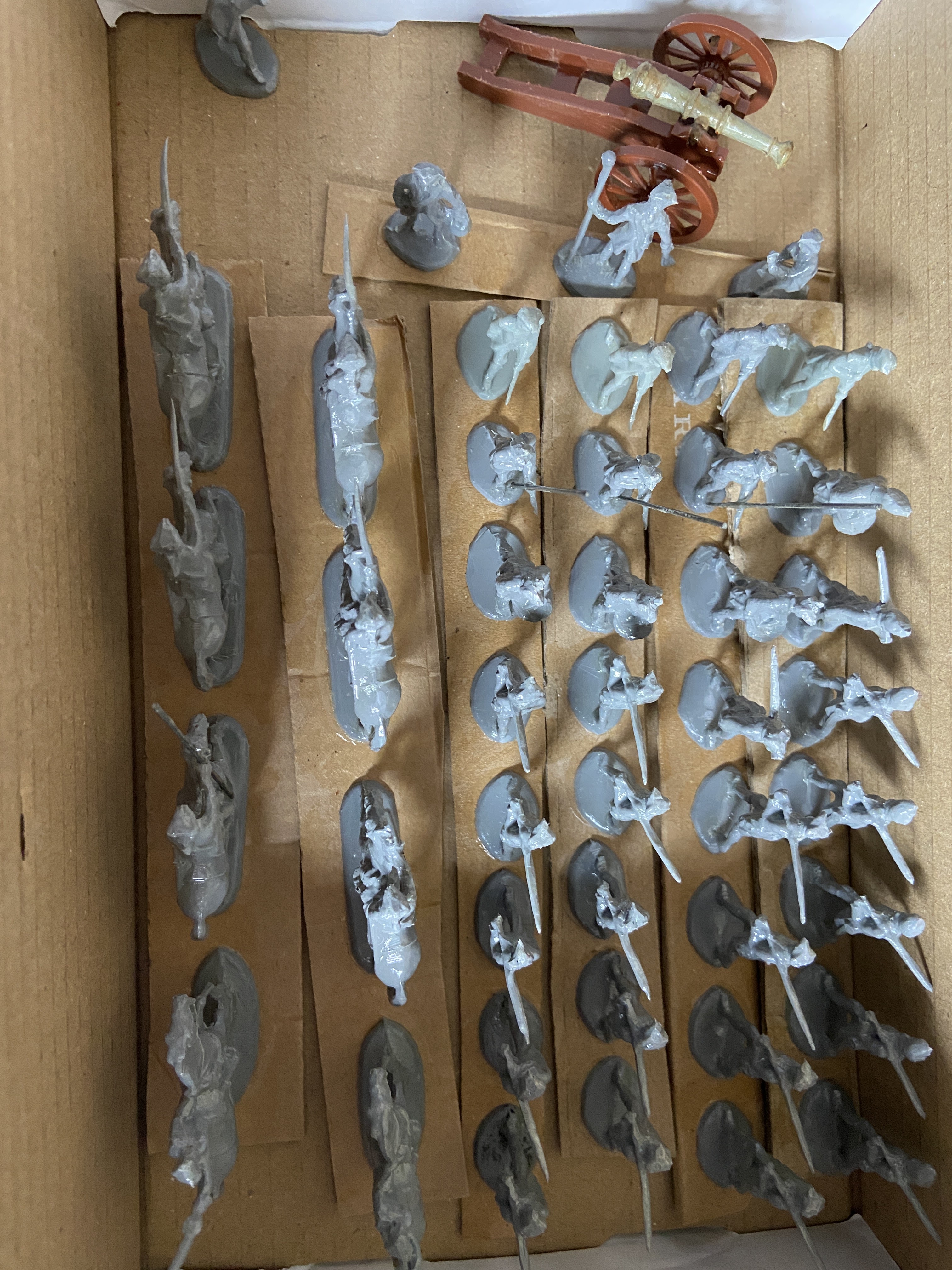
Work on the army of the Grand Duchy of Waldow for the Soldier King project has progressed. The figures have been painted and varnished and are awaiting flags, bases and labels; they may also get another "Grotesque" character figure as I found one lurking and after considering the enlarged army, thought they needed another senior commander.

By way of  teaser, some pictures.

The army in the box.


Cavalry


Infantry


Artillery


The Grand Duke and Von Stauffen


Hopefully more to follow when complete.

Sunday, 30 March 2025

So what I have I been up to...

Well, as per last post, I have attempted to remain focussed on the Solder King Imagi-Nations project. It has been difficult as I find myself drawn towards other projects (F&IW, AIW, WW2 desert) but have knuckled down to the painting of the next state - Waldow.

In the game, Waldow is divided into a "lower" and "upper" province. I decided to amalgamate them into a single Grand Duchy. It is not an electoral state, but is a ripe target in the game should you wish to increase army sizes. It is bordered by Arcadia and Bravance, with Banst to the north and Estavia to the west.

The new calculation of army sizes has increased the planned forces to a war footing of 18 units, a respectable force just slightly weaker than the main kingdoms with 24 units. I suspect it will need them. It is ruled by a Grand Duke with no wife, heirs or other family which could create a succession crisis. The Grand Duke Xenophon Amadeus has some strange ideas and despite his misanthropy is rumoured to have decreed in his will, that on his death Waldow should become a republic! The scandal!

Waldow has had some colour ideas for a long time; very much influenced by Sweden and the German units which served France, the heraldry and uniform colours are based around light blue and yellow, with white and occasional dark blue. The flags have been more taxing; partly due to not being able to settle on a heraldic device. The original idea of using some GW Brettonian transfers, left a lion passant as the device but this seemed too close to Arcadia's lion rampant. As the idea of using transfers was largely abandoned, I could in theory opt for anything. Obtaining some Veni Vedi Vici decals gave an option of a swan, which has appealed as different. I'm concentrating on the figures at present, the flags can wait.

Here are the first infantry; in actual fact I have almost finished two more units the same; others will have variations in waistcoat and breeches - some all yellow, some all blue. Forgive any errors from the enlarged photos - it's only after a zoomed in photos you notice such minor errors!


And just for Jonathan, as I know he likes my scribbled sketch ideas for uniforms, here's a succession of thoughts and experimental manuscripts from the Ducal archive, the last including potential flag patterns / ideas.


Sunday, 23 March 2025

Soldier King project update

After much lethargy, distractions and a lack of focus, I have attempted to get my wargaming mojo back by concentrating on part-completed projects. One of which, is of course the Soldier King project using plastic Spencer Smiths.

The completion of the army of  Banst seems to have sapped a lot of the enthusiasm for the project; not sure why, but I couldn't seem to get the army finished. Plans for work over Christmas were scuppered by illness and work has been draining and sapping any energy at the weekends.

A visit to Hammerhead and an improvement in the weather has helped, as well as a refocus on work-life balance. Without going into details, developments at work have left me with a different perspective and I think I will be able to afford to retire at 65 after all; only another three years after April!

As such, I have returned to the SK project. There are three armies left to do for the non-Electoral states of Waldow (upper and lower amalgamated), Sinistria and Dupanen. In addition, I have started converting figures suitable for Rebels or Civilian militia. My original plans were disrupted by a couple of factors; the Kingdoms of the game each have armies of 24 units plus artillery and commanders. The game gives each 12 "income" points. The very first idea was to have 12 units, one for each income point. Part way through, after completing Bravance and Hrvatska, I realised the armies were too small, so doubled them.

Unfortunately, when I added Estavia and the Electoral and non-Electoral states, I did so in a rather haphazard way; The Electoral and non-Electoral states had army lists drawn up from the income points. Banst (as always) proved more difficult. To get the level of army I wanted, I increased the number of units which meant it was unbalanced compared to other Electoral states but in line with the kingdoms.....

I went down several rabbit holes trying to balance it all out, getting very confused with how many boxes I had to store the potentially increased armies as well as becoming disillusioned with the amount of increased painting and cleaning up this would entail....

I'm sure this all contributed to my flagging enthusiasm. A sudden lightbulb moment helped; if I took one income point as the cost to raise a unit and half a point to maintain it, I could reconcile the army sizes to the income in the game and scale back to amount of new units that would need painting...

One way to look at it was if all income was used, the states was on a "war footing". I also thought that the "Rebel" figures could also become a militia to boost some states armies. Looking at the map also produced some thoughts; the non-Electoral states are in the front line for any invasion by the four kingdoms, especially Waldow; the Empire may have to fight on more than one front and the various Electoral states may be pressed to form a single Electoral army without losing territory...

I have therefore decided to expand Estavia and create some "Imperial militia" that can be used to bolster the Electoral states in addition to any civilian militia they call out. The non-Electoral states will have to be on a war footing......

Sadly, the pictures that follow are not that exciting, but I have managed to clean-up a lot of Spencer Smith plastics (a job that entails carving away the flash that surrounds the figures) wash in detergent, glue standards and varnish (I coat the figures in a layer of acrylic varnish before undercoating and painting) the extension to Waldow. Just awaiting suitable weather for the black spray undercoat.


I have also just cleaned the excess plastic from the army of Sinistria; since the picture was taken I carved down the blanket roll on the blue figures - these will be light infantry modelled on the Russian copies of Austrian Grenzer. I also discovered that one of the replacement Grenadier heads had disappeared - there followed much cursing and swearing followed by a fruitless search and acceptance I would need another donor figure, which was dug out of the lead and plastic mountain in the garage....

I took this as a sign to put it all away in bags and back in the box.....


On a related note, my friend Eric Turner in the USA has been working on Imaginary Napoleonic forces from old school 25mm figures donated to him - see his blog: 

https://brownspreadandyellowfruit.blogspot.com/

Eric was lacking artillery crew and generals so I dug out some old Hinchliffe destined for the melting pot; I also asked if he would like some "Grotesques" to act as generals....after some discussion Eric asked if he could have something "heroic" and something "reluctant" so some work with Sculpey produced:


Crude and ugly they may be but also 100% unique!

Sunday, 9 March 2025

Hammerhead 2025 - the photos

As promised, a photo dump of pictures I snapped at the show. There were lots more games, some not very photogenic; these are just games I found interesting for one reason or another.

VBCW


Boondock Sayntes - Fords of Isen


Midgard Troy in 1:300


French & Indian War - Derby raid on a native American village (needed more trees IMHO)


My personal favourite - To The Strongest Glorantha / Runequest - Battle of the Horn Gate Prax (no apologies for number of photos)


The Crimson Bat! 


Chaos waiting in the wings....


A very cluttered 10mm League of Augsburg game


Peter Dennis paperboys Egyptian v Hittite


WW1  Zero Hour


Fitzaubrey Last Hurrah


The Bunker Shaun of the Dead


My mates from the Tyneside club - Death on the Nile scratchbuilt 10mm Egyptian and Sea People galleys


A Small table game - Deathship?


An Italian Wars game using an adaptation of Fire & Fury ACW rules


Lots of other games that were either too busy to get near or not very photogenic IMHO .

Had a long chat with people from the Tyneside group and a shorter one with Simon Millar and Ian Notter with the Glorantha TSS game.

Sunday, 2 March 2025

Hammerhead 2025

Yesterday I went to Hammerhead at the Newark Showground. Pictures will follow once I get them organised and catalogued to the games.

Impressions

I got there around 11.15 and left around 15:30. When I arrived, people appeared to be already leaving, although could just have been putting stuff in their cars.

There was a queue, unprecedented in my experience unless turning up before a show opens. I was therefore expecting it to be busy; it wasn't. I think the queue was down to the entry system, with one person taking entry fee, one putting on the bracelet and another handing a plan, which sort of created a delay in filtering people in. I have to say I saw lots of people bypassing the entry - some were carrying boxfiles so may have been part of the DBA competition. I'm sure if you had just walked in  confidently enough, especially if carrying something, I doubt you would have been challenged.

Big plus, a printed floor plan! I did note Bacchus seemed absent, although I may have just missed them / assumed the stand was part of Warlord.

The show remained busy throughout without becoming crowded. The traders seemed to be busy, except for a few "niche" stands. The "bring and buy" was a strange mix of three deep or empty spaces, depending on what was being offered for sale.

The games were a mix of bigger tables and very small 3'x3' or 4'x4' with a lot of sci-fi and fantasy mixed with historicals. Some of the bigger "traditional" games looked unplayed, with the odd punter maybe speaking to the person(s) putting it on. Other bigger tables with traditional wargames looked as if the players were the ones putting it on, as they didn't change throughout the day..... 

A few games have been at other shows, some were new. The terrain was mixed, from TSS tiles or green cloth to sculpted, ratty looking trees to dioramic masterpieces with everything in between. The DBA competition looked especially grim and could have been from the 1970s or 1980s......horses for courses I suppose.

I spent a lot of the day speaking to some old mates from the Tyneside Wargames club who were putting on Death on the Nile - scratchbuilt 10mm Egyptian v Sea  People naval battle created by Pete Foggin, who grabbed some coffee stirrers for more ships! I did see Martin Rapier as I was talking, but didn't manage to speak to him or bump into him afterwards.

I did have a chat with Simon Miller and Ian Notter who were there with a To the Strongest Glorantha / Runequest game featuring Ian's Praxian Nomads and Richard Crawley's Morocanth (I only worked out it was Richard after I had walked away) as well Simon's lovely troops including the Big Red Bat itself (display only). We chatted about adapting the rules for Glorantha and model Sables, Impala and Antelope......

A good day out, finished with a good VWC session, left me feeling as if I've recovered some of my wargaming mojo....

Sunday, 23 February 2025

Thoughts on the battle of Pavia 24/25 February 1525: "God grant me 100 years of war, and not one of battle."

My apparent silence on the blog is mostly due to a profound lack of wargaming activity and continued lack of focus and distractions. I have however, been reading and researching the battle of Pavia. The words in the title are credited to the Marquis of Pescara. for the unwary researcher of the battle, a version might be "grant me 100 sources, and not one agrees!"

Suffice to say, what actually happened on that dark overcast night and misty morning 500 years ago cannot be established with certainty and even the number of men who were engaged is far from certain. Few of the contemporary accounts agree or give more than hints of detail. "Modern" historians from the early to late part of the C20th have taken bits from here and there, discounted some accounts, even walked the ground and created versions of the battle that have been repeated without question, especially by wargamers....

Even the contemporary accounts were written to excuse or glorify certain nations, with French, German, Spanish and Neapolitans each seeking to take ownership of the victory or explain why the French lost so badly. It has even been questioned whether the Imperialists were seeking battle or merely conducting a raid to resupply the besieged garrison.

To make sense of the battle, it is necessary to split down the various parts into the geography, the forces, the actions / sequence and ideas for refighting the battle as a wargame.

Geography

Perhaps the biggest handicap is a good map of the actual battle. More than one modern author has been led astray by failing to grasp some of the geographical aspects. Not least is the failure to grasp that there were in fact TWO parks, the old and the new, divided by a boundary wall. Many maps do not make this clear, omitting the wall encircling the new park. In turn this has led to many historians opting for a point of entry that is both unlikely and not supported by the sources.

While searching for more information on the appearance of the walls, gates and the Mirabello palace, I discovered an Italian book "Mirabello di Pavia" by Faustino Gianani. This is a history of the park and palace and devotes a chapter to the battle. Translated laboriously with the aid of a translation pen, it demolishes many of the myths and supports the arguments given by contemporary or near contemporary sources.  It serves as a useful counterpoint or corrective to "The Battle of Pavia" by Jean Giono, which is an otherwise essential source for the battle. In particular, it casts doubt on many of the locations given by Giono and credited with special significance. No where is this more important than the location where the Imperialists broke into the park.

Giono, following the German historian Thom, opts for the point of entry as the Porta Pescarina and discredits an contemporary resident of Pavia, Antonio Grumello who gives an authoritative description of the break in at the Duo Porte on the east wall. To reach the Pescarina gate would require rthe Imperialists to first break through the encircling park wall before then breaking into the northern boundary wall at the Pescarina - which despite the name has no connection to the Marquis of Pescara, already being so named. A map should make things clearer; many omit the new park wall and so give credence to the Pescarina gate theory.


Credit:https://www.battagliadipavia1525.it/the-battle-of-february-24/?lang=en

Three breaches were made by 2000 Gustatori - pioneers - the gate itself and one each to either side.

Initially, I thought the Pescarina gate more likely as there is a road and the ground was described as boggy. Interestingly, while the walls are long gone and the Mirabello palace much altered, two of the gates themselves still exist.

Porta Pescarina


https://www.lombardiabeniculturali.it/architetture/schede/1A050-00589/

Torre del Mangano


https://www.collegeofkings.com/pavia-park-walls/

It also suggests to me the encircling wall and dividing wall were possibly of different styles. A contemporary woodcut suggests the main walls were crenelated in the Ghibeline style. 


https://www.alamy.com/the-battle-of-pavia-woodcut-image477878287.html

The woodcut also shows the appearance of the Mirabello palace, much altered today.


Note on the map the large and small woods and the marshy Vernavola stream. Giono points out most of the trees would have shed their leaves the eastern wood also having dense undergrowth. The Vernavola may have been wooded and there is a raised road, used for horse races by the Dukes of Milan.

Forces

Note few sources, either contemporary or modern agree. The following represents the best estimate I can reach after consulting various sources.

French

Gensdarmes 1200 to 1300 "lances"  giving between 3600 and 5200 + heavy cavalry

NOTE it is common to refer to the number of heavy cavalry by "lance" - a lance included between 3 and 4 extra fighting men such as "archers". The French attacked "en haye" so the lighter cavalry would support the fully armoured knight in the same formation. This is supported by a Spaniard Iacobo De Neile who gives the French 2000 heavy cavalry and 5000 light - if we deduct the known 2000 LC this gives 5000 - a mixture of fully armoured and lighter cavalry. Some may have been Italian.

2000 Light cavalry including 700 Stradiots, the remainder mounted arquebus or crossbow, some of whom would be with Medici's Black Bands and so take no part in the battle.

8000 Swiss - most likely in two bodies of 5000 and 3000 - many had gone home or deserted prior to the battle. Maximum 10,000 though doubtful and may be many less than the 8000 given.

4-5000 Landesknechts including the Black Band, possibly in two bodies as both Lorraine and Suffolk are given as commanders

53 guns

There were also:

6000 French and 2500 to 4000 Italian infantry. These appear to have been left in the trenches surrounding Pavia. There s mention of 2000 Gascons with the king, but the others were either Medici's leaderless Black Bands (he was wounded before the battle) or French under Alencon who retreated.

Imperialists

700-800 Lances (as above) giving between 2100 and 3200 heavy cavalry

NOTE these included 500 Bavarian MAA under the Count of Salm and 500 Burgundian knights - the German cavalry supposedly fought in a deep wedge formation while the Burgundians fought like the French. The remainder were Spanish and Italian.

1500 light cavalry - Spanish or Neapolitan Ginetes

12,000 Landesknechts under Frundesberg and Sith - probably two bodies of 6000

5-7000 Spanish - most agree on 5000

3000 Arquebus made up of equal amounts of Spanish, German and Neapolitan - sometimes given as all Spanish or Neapolitan - Guicciardini says 6000 equally divided between those nationalities

16-17 guns

3000 Germans and 2000 Italians were left to guard the camp

Pavia Garrison sortie

200 dismounted knights, 3000 Spanish 6000 Landesknechts - maybe only 5-6000 sortied out

All numbers could be much lower for both sides.

Sequence

The Imperialists were said to have divided themselves into two bodies of horse and four of foot - the arquebus task force under del Vasto, the Spanish and the two German bodies. The arquebusiers and artillery passed through the breach nearest to Pavia and the gate itself respectively, then the first of the cavalry with the remainder in turn - I suspect the second body of horse was last. The first had both heavy and light cavalry. This looks like a column which could turn itself quickly into a line of battle.

At some stage the French became aware. While the arquebusier captured Mirabello and the camp of traders by surprise, it seems the artillery became stuck and were attacked by French cavalry (possibly light) and possibly Swiss. The artillery was captured the troops with it fleeing to some woods.

French artillery - either mobile guns moved up, guns entrenched in a French camp previously began taking the Spanish and Landesknechts under fire, causing them casualties and forcing them to shelter behind the raised road and whatever cover was available.

Francis arrived with the French cavalry and charged in masking his guns. He was counter-attacked by the Viceroy of Naples with the first body of cavalry, including some lights. Outnumbered, they gave way. Pescara with the Spanish and possibly del Vasto took the French cavalry under fire.

The Landesknechts under Frundesberg may have tackled  a small body of Swiss (3000) on the French right flank who routed.

The Black Band Landesknechts came up to be attacked by the Imperialist Landesknechts who surrounded them and gave no quarter.

A second body of Swiss moving from the abbeys encountered their fleeing comrades, routing French cavalry and may have been attacked by a sortie from Pavia, they too routed away to discover the bridge over the river broken by Alencon, so many drowned.

The French cavalry now found themselves fighting infantry and possibly the second body of Imperialist cavalry plus whatever Naples had rallied. No longer able to charge, possibly in boggy ground they were slowly cut down and the king captured.

Wargaming the battle

Many wargames scenarios have the two armies lined up in a set piece battle. My reading suggests this was not how it unfurled. The Imperialists should have the capture of Mirabello as an objective.

As they are deploying with troops moving through the breaches, a French advance guard appears -opposite the Imperial artillery -  cavalry and 3000 Swiss? The artillery seem to be alone so perhaps the arquebusiers had gone and the rest of the army was making it's way in.

Artillery is deployed by the French who take the Imperial infantry under fire. Are the advance guard deployed to protect them?

Francis arrives with the French cavalry and charges masking his guns so must be deployed facing the first Imperial infantry and Spanish. The French Black Band Landesknechts are still making their way forward.

So both sides are feeding troops in with a piecemeal arrival. Francis - something of a rash individual - probably thought his charge would sweep the enemy away, so it's unlikely they were fully deployed.

It probably needs some form of random entry with built in delay: for the Imperials (1) Arquebusiers, (2) artillery, (3) cavalry, (4) Spanish, (5) and (6) Germans, (7) second cavalry.

For the French (1) advance guard, (2) artillery, (3) French cavalry, (4) Black Band, (5) Swiss main body; the Imperialists should also be able to bring on a sortie from Pavia - historically a signal from guns in the Imperialist camp let the garrison know the relief was on the way.

I hope this has been of interest. While I won't make the 500th anniversary on the date, I do hope to finish my flats and refight the battle this year with any luck...

Sources

The best is The Italian Wars Volume 3 Francis I and the Battle of Pavia 1525; Massimo Predonzani & Vincenzo Alberici

The Battle of Pavia by Jean Giorno was once the definitive source, still useful with much on the terrain and background but flawed

Mirabello di Pavia; Il Parco, La Battaglia, La Parrocchia by Faustino Gianani is useful to correct some of the fanciful aspects of Giorno

Francesco Guicciardini The History of Italy is available in an antiquarian translation - be wary of the English modern translations as these are extracts omitting any of the details of battles for the most part! For Pavia you need books 15 & 16

Oman is virtually useless. Konstam's Pavia 1525 by Osprey is a rehash of secondary material - the maps for example end at the corner of the old park and new, giving the impression no other walls exist or simply omit them completely, moderately useful but approach with caution.

I have looked at various articles both written and on the internet, as well as various wargames scenarios, most of the latter are pure invention it has to be said. I'd also recommend the various woodcuts and paintings as well as the series of tapestries to give some period flavour, although most paintings are completely inaccurate and speculative. the tapestries are available in a large format book.

Progress - Celtic muster

This week I managed to get some more Celts done - some were with Contrast Paint on white or grey and some black undercoat with normal acryli...