Sunday, 17 August 2025

Problem children - Indians & Honeys-modelling madness part 2

The title refers firstly to the discovery that the Indians I had primed needed some remedial Greenstuff work and unfortunately, the primer on the bases had started to peel...

After the Greenstuff, they received some PVA with white acrylic watered down - fingers crossed it seems to have taken.


While I was at it, I carved about and swapped some heads with the Atlantic Indians - they will probably become 3rd Indian Motor Brigade...


I also did some more from the Strelets box but have not yet primed them.

While the peeling paint tested the patience, it was nothing compared to what followed....
I first tackled the IBG / World at War A10 Close Support cruiser - a relatively smooth build only handicapped by a small part pinging off and an inability to find the razor foil I had used on the other A10 - after a frustrating and fruitless search, I ordered some brass mesh.
The only problem was having to rely on a PDF set of instructions for the A10 cruiser 2 pdr version - there were some differences, but nothing too challenging; I even found a replacement box....

Putting the A10 to one side, I started  the Mirage Honey.....

It is said that the name "Honey" was given to the M3 by a British driver testing one of the first vehicles...."It's a honey sir"
All I can say is that I cannot say the same about any of the 1:72 M3 Honeys I have built!😠

It would be fair to say, this was a "challenging" build.....while a plastic kit, it comes with not only photo-etched brass parts but also 3d printed resin....
The first problem was that many of the parts were so thin and tiny, despite care, they broke an removing from the sprue. The instructions were....well interesting and not always very helpful, but I followed as best as I could. The wheel assemblies while detailed were unnecessarily complicated and again, when removing I broke one of the "arms" connecting the wheels.

I progressed to the tracks - two options were provided; rubber band type and 3D printed. After the Hasegawa model, I opted for the 3D printed tracks. They had to be removed from the supports - what I didn't realise was they also had support material between the teeth across the tracks....
This led to some problems getting them around the wheels and needed a lot of work to get them to fit.....disaster! One of the flimsy wheel assemblies broke and it and a road wheel disappeared never to be seen again.....(I did however find the part from the A10 that had been lost!)
I also discovered, that all the fine parts (MG , light brackets) fitted as per instructions had broken in my struggle to fit the tracks and the tension had detached one of the rear wheels.....

At this stage, it all went back in the box and I packed in for the weekend.....😠

The following week, I dug out a 1/87 Sherman wheel of roughly the correct size and repaired the missing  wheel. Again, back in the box to await this weekend when I finished the repairs and built the rest of the model. The turret was a nightmare; a long scored piece of plastic to fold for the side, separate top and turret parts, none of which, it has to be said fitted very well......
I also found it simply sat on the hull. No key or peg to hold it in place. As I had not fitted the front visor and driver hatch plate, much of the inside was visible. It was at this point that the insanity took over....😕

I decided to fit a driver and somehow replicate the internal turret basket which would be just visible through the driver hatch......😛

Repaired wheel (front|)


Turret fettling a steel washer and some cut about plastic tube...


Driver - the 3D printed figure supplied cut about into a sitting driver in the early US crash helmet...


Can you see me?


Not finished with me, you can see one of the brass straps which pinged off and had to be replaced...


The A10 was finished once the mesh arrived - early cruisers had an exhaust guard


The missing box was replaced


And in all it's clunky goodness....in two minds whether to fit the auxiliary fuel tank on front fender


I then moved on to the IBG Crusader 1 CS version - some PE parts...
All in all a reasonable quick build, with some (IMHO) unnecessary complex separate parts. Only problem was on fitting the PE brass part side skirts, I discovered that the instructions were wrong....you are provided with 3x sets of fenders - presumably for the different versions made - and there are spare redundant parts such as the 2pdr barrel. It was only when I fitted the side skirts, I realised the suggested part was in fact wrong - it was another of the supplied fenders as it lacked the detail on the front corner. I resorted to removing the corner from another set and thinning it down - I couldn't face removing and replacing.....
Here they all are with some AB crew figures  to see how they will look...


Troublesome Crusader 


I then dug out the other models t see how they matched.

7th Armoured Brigade with its mixture of Cruisers and Crusaders....


22nd Armoured Brigade County of London and Gloucestershire Yeomanry in Crusaders


4th Armoured Brigade - Honeys


Spot the drivers!


You will note the disparity between the Hasegawa and Mirage models although both they and the PSC are all supposed to be 1/72 scale......

Comparisons

Honeys front top Hasegawa, front bottom Mirage, rear Plastic Soldier Company


It may be a case of "that one is far away".....😂

Crusaders  L to R Armourfast, IBG, Airfix, S-Model


Side


May take a rest from modelling for a bit!

Sunday, 27 July 2025

Indian!!

The title of this post popped into my head from the wonderful TV series Goodness Gracious Me where in a series of sketches, an Indian father insists to his son that everything from Christianity to the British Royal Family are Indian......

https://youtu.be/8tw7LIykvBw

Many Indian Army formations and units fought in the desert in WW2, the first and most celebrated was Fourth Indian Division. For the period I am interested in at present, the three infantry brigades comprised a British and two Indian battalions, with lots of variations and substitution of entirely British brigades.

I have previously mentioned how, as a callow youth I encountered the Atlantic Indian Brigade plastics in the Toytub in Edinburgh, but passed up the opportunity to buy them, a decision regretted for many years. Had I bought them, I suspect I may have been disappointed.....

The pictures that follow are from the excellent Plastic Soldier Review website:

https://plasticsoldierreview.com/Index.aspx

It was the lurid (and inaccurate) box art which hooked me:


Unfortunately, as the PSR review makes clear, the accuracy, weaponry and animation leaves something to be desired....


What they do have are wonderful turbans!

For many years, that was all that was available aside from transplanting Indian heads onto British bodies or painting British figures with darker skin (most wore helmets in battle aside from Sikhs) or use metal - most ranges just have Sikhs though.

Strelets raised the bar by releasing a set:


The figures are mostly considerably more accurate with less silly poses, although as PSR remarks there are problems with some weapons...


Some figures are simply fantastic such as the radio operator. Like the Atlantic set, they suffer from a mix of turban types that would be unlikely to be seen in the same unit; the Indian Army was organised along regional / tribal lines, each with their own distinctive pagri as this C19th illustration depicts:


The only exception were Sikhs, who often formed companies in other battalions.

I was guided by the above and photos in The Tiger Strikes and the Tiger Kills (HMSO publications about the Indian army in WW2).

So I decided a little "Frankensteining" (or is it "Frakensteening"?) was in order and there followed an agony of lopping of heads, pins and sore thumbs.....


Glueing turned into a nightmare as some heads insisted on rising above the pin, despite lots of insertion and pressure. Gaps were filled with liquid green stuff and a coat of diluted PVA, some fettling and a spray undercoat / primer later we have:

Maharattas (note some figures have steel helmets on back or belt - I felt removing them would result in more problems to correct so used Pagri heads for them while the majority has steel helmet)


Punjabi -note two slight variations in turban


Atlantic do a nice Punjabi head, so I may convert another unit

Rajputs and Rajputana Rifles


Sikhs


There are lots of other useable figures from the Strelets box and a few from the Atlantic (with some more heads) and these will be used for the Indian Motor Brigade or squadrons of the CIH as well as possibly another Indian division.

Also, deciding I had not endured enough, I made the decision to increase the number of tank models - I'm finding 1 model per 30 tanks is a good ratio, allowing DAK to have a mix of types. Unable to find the other Hasegawa Stuart and after lots of deliberation, I dug out what had intended to be the HQ vehicles for each of the brigades.....

Fortunately, despite the Mirage model having rubber tracks, it also comes with 3D printed versions and the other two have moulded tracks / wheels. Sadly two do have lots of PE brass bits including side skirts.... as these are "proper" serious models....


I'm working on the idea that short weekends allow for more of this type of thing and some Contrast Paint  work and longer leave is best for the Soldier King project as it takes longer. I do however keep thinking I need to get more of the Italian Wars flats done.....

Saturday, 19 July 2025

Modelling madness....

This week I have been mostly making 1/72nd kits of tanks......

My embryonic British desert forces for Operation Crusader received some reinforcements. The PSC Honeys are hugely overscale, so the only option I could find was an ancient Hasegawa model (I couldn't face another PSC model) - the idea being this would become the brigade HQ tank.

While hunting for reference material, I chanced upon a modelling site with a 1/35th version which may have influenced my subsequent actions.....

The Hasegawa model come with separate hull hatches and somewhat unadvisedly and ambitiously decided to model the driver hatch in an open position , realising belatedly that this may require an actual driver.....

A suitable donor was provided from the Airfix Quad and 25pdr kit, mounted on a seat from the spares box (probably Roco) and a lot of fettling followed to ensure he fit when the top hull was mounted....

The major challenge became the rubber tracks......foolishly I attempted to melt them together and then tried to use superglue to set them in a suitable position.......lets just say it was "challenging"!

Lots of details were added to the model to make it more British and the gun required some work to make it look right.


The horror that is the tracks when they eventually set....


Out of focus picture of the driver...


And when the top hull is in place, you can just see his face peering through the hatch if you look closely...... the important thing is I know he's there!


The Yeomanry of 22nd AB received a command Crusader, in this case Armourfast; despite miniature instructions and not obvious locating points it went together reasonably OK. I added various details and decided to scratchbuild an auxiliary MG turret - the turret hatch was modelled open so an Airfix Crusader was used as it was much nicer - initially I'd used the Airfix MG turret but it was too small. It will be donated to a Cromwell Combat Ready model mark I.

Scalewise, it's huge. Much bigger than the S-Model Crusaders, but not so big as to be jarring. The turret needed heightening after completion.


I was intending to add another A10 Cruiser - 7th AB had a mix of Crusaders and worn out cruisers - in the end I discovered I had the BEF model which is totally different, so the Airfix model came to the rescue as I couldn't face the amount of scratchbuilding required to convert the A10.

The Airfix model must have been at least 40 years old and came without instructions! The internet does have its uses and I found a PDF. I was hesitant as I know there are problems with the Airfix kit - lengthwise it is 1/72 but widthwise 1/76, the turret is too small and it had those rubber tracks - in this case very old rubber tracks....

Despite this, it went together very easily and even the tracks cooperated to some extent - I tried sewing them together with invisible thread - one worked, but the other split - I ended up melting more rubber to join them and lathering the join in superglue. Amazingly, they were slack enough to fir on the model without problems and were secured by more superclue and covered by the side skirts. Despite the issues with it, it seems to represent the worn-out crocks the 7th AB were equipped with....


The turret was modelled closed, using the Armourfast part and another MG turret was constructed. All in all it has turned out OK.

When I find time they will receive some lovely AB crew and various stowage. I have already spotted some bits I need to tweak....

Sunday, 13 July 2025

A parade - Sinistria

Another Soldier King "army" completed; although it represents the entire strength of the Duchy, it's more of a contingent of 9 units.

The Duchy of Sinistria is a small province on the borders of Hrvatska and the Electoral states of the Empire; as it has no Electoral city, I see it as nominally part of the greater Imperial states but independent and non-aligned. Originally, I had planned for an army half the size, but realised it's precarious position meant it was at risk on invasion and conquest; coupled with a revised mechanism for recruitment, a doubling of the force was necessary.

By the time I got to devising a uniform scheme for Sinistria, I was running out of ideas. A chance discovery in the Blandford "Uniforms of the Soldiers of Fortune" of a Dragoon in black uniform - a member of the short-lived Freikorps von Favrat was enough - the name of the duchy with it's hint of "sinister" seemed to confirm the choice of black as a uniform colour.


The rest followed easily; the family names of personalities tend to follow colours or colour related words in German; hence the Landgraf became Augustus Maximillian Schwartz with his army of the "Black Brigades". The heraldry was a mix of black, red and yellow which determined the flag colours; the heraldic symbol was originally a head - griffon perhaps? This morphed into a Griffon or Dragon. The Landgraf's rolled up character was that of an honour conscious, arrogant and corpulent individual. Out came the Fimo and a suitable "Grotesque" was sculpted - in fact he came out quite well, my "eye" being definitely "in" as it were due to multiple sculpts around this time. 

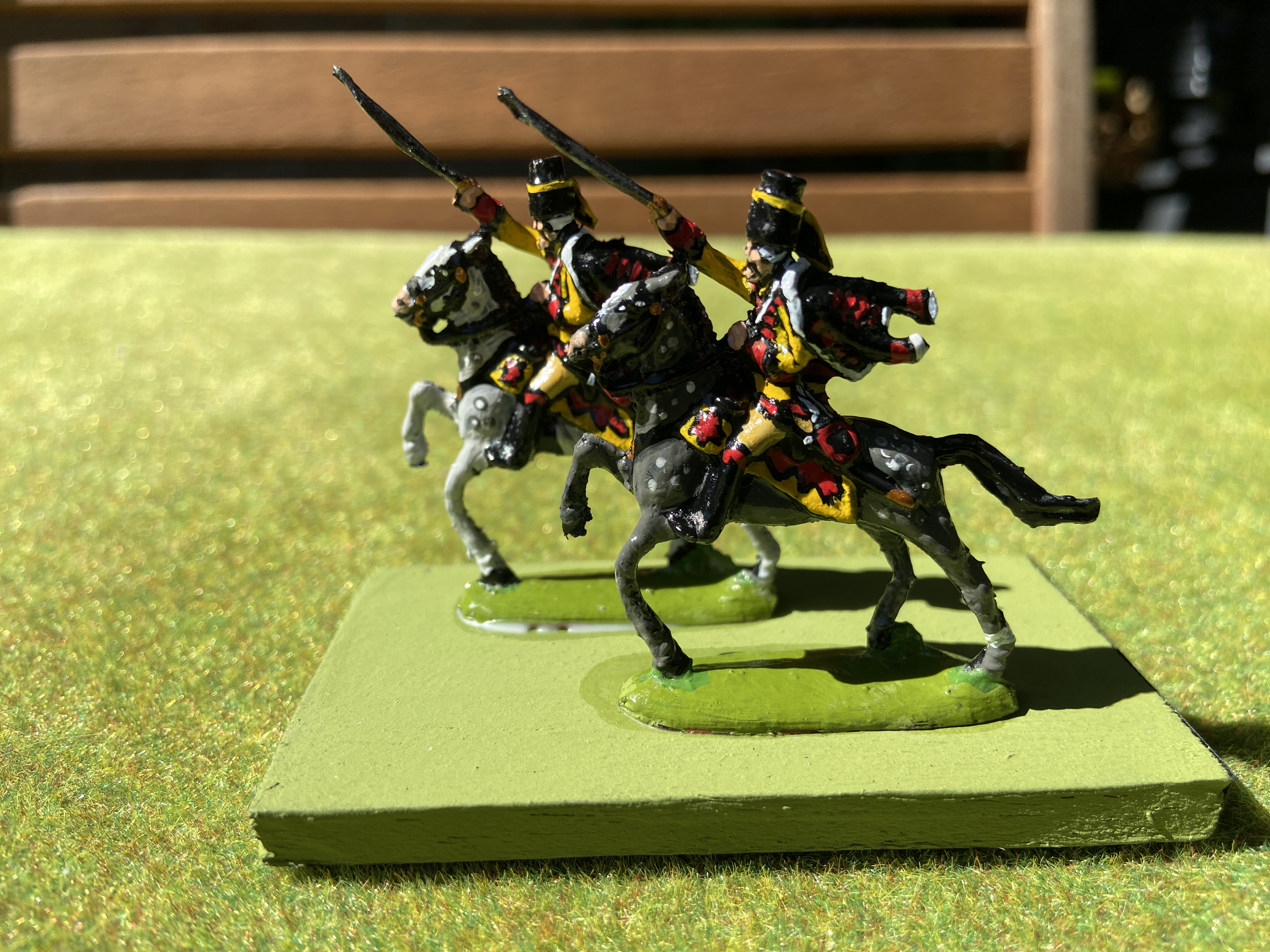
Instead of a Freikorps, it was expanded into Dragoon regiments, musketeers, hussars and Pandours and artillery were added using Russian uniforms as inspiration. The Grenadiers all had head swaps (and Greenstuff additions) from the AWI plastic range added by Peter Johnstone - smaller than the original SSM but with Prussian style mitres. The Hussars were conversions to mirlitons - some old figures acquired in a host of plastics with odd bits of red and black enamel and individual names / ID on their bases - true veterans of some childhood battles! With a black undercoat, painting was relatively quick.

Due to his "corpulence" the names of units were derived from meat and fish dishes....there are not enough place names in the Duchy!

Landgraf Augustus Maximilian Schwartz von Sinistria


Son - Furst or Markgraf von Sinistria


Von Lorch and Von Monzel


The Leber and Truthahn Gragoons


Kopfel Hussars


Schnitzel and Wurst Regiments


Katenspeck and Schinken Regiments


Kabeljau Pandours


Artillery


The army on parade


And in their storage box


I am often asked "when will we see them in a battle?" Sadly, I still have more painting to do as well as buildings to construct (Schreiber and other East European card buildings). Add to which, I have nowhere currently to play. While the completion of Sinistria is a milestone in the Soldier King project - only Dupanen remains of the states - I also need to complete some "rebels" who will also double as civilian militia and bot Estavia and the Electoral states need expanding, Estavia having another brigade of infantry some cavalry and grenze to paint.

Perhaps a project for retirement?

Micro musings

Blog silence is due to a couple of factors - work continues to be an unremitting drain on time and energy which reflects in little progress ...