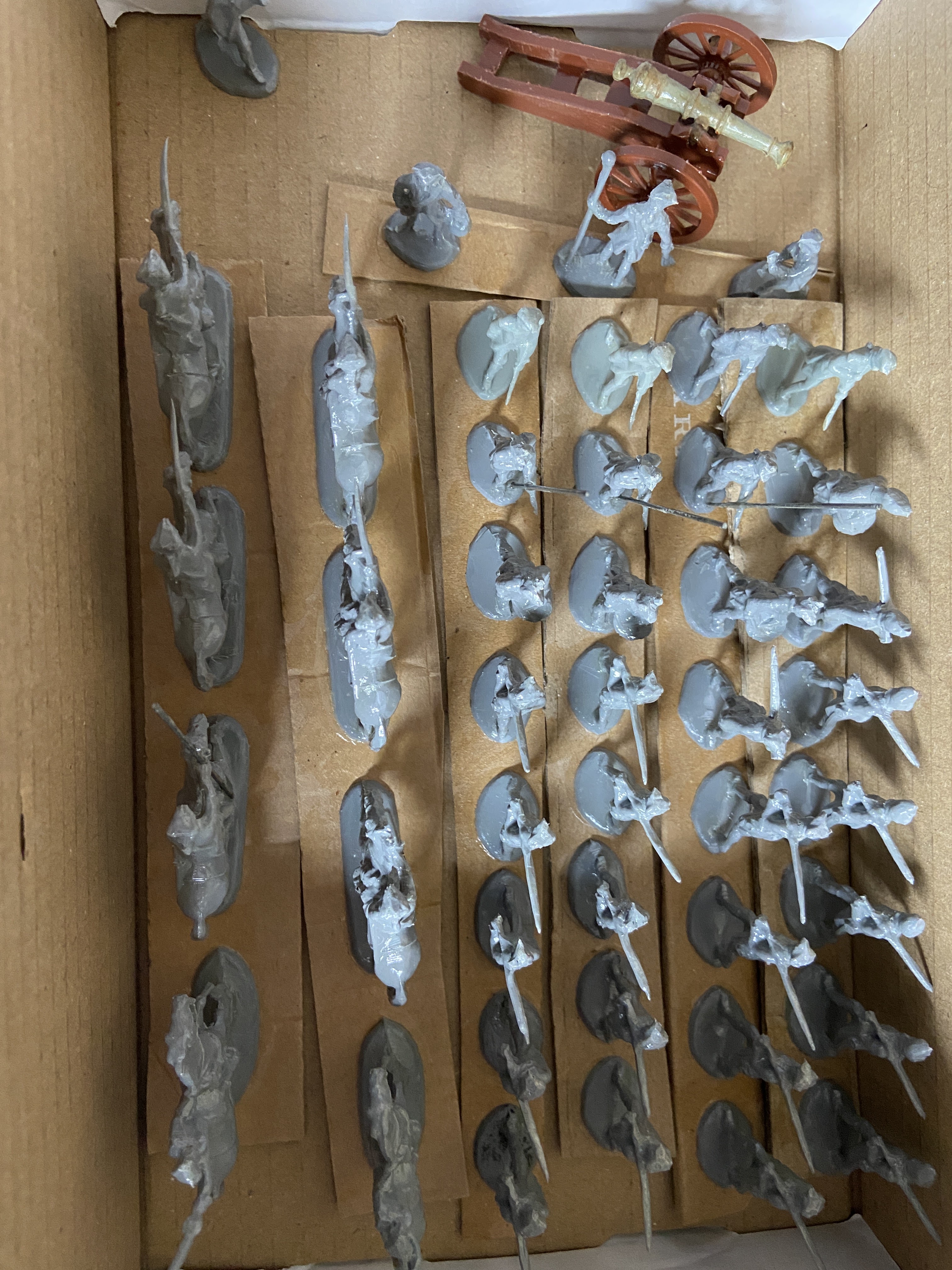
Rather than post pictures of painted and unpainted 15mm barbarians, something different.
To be honest, the last batches of Germans have at times been a chore; I suspect it's the numbers - 40 odd 15mm figures can sap the most enthusiastic painter and I have been flagging and getting frustrated with things like shield patterns. I don't really have a lot to do, some cavalry, light infantry and camp followers plus some command stands and that will be the German horde. There are a lot of odds and sods; Roman tribunes and baggage, plus camp defences. I think I will tackle them in small batches.
So, with the family away for a few days, I had access to the kitchen table without interruption. I decided I would play a game, but what?
For a bit of fun, here's the table laid out in the early morning sun. Can you guess the battle? A clue it's from the SYW.....

Answer? Lobositz 1756 the first battle of the Seven Years War between the Prussians under Frederick the Great and the Austrians commanded by the "wild goose" Marshal von Browne.
I first encountered the battle in Battle for Wargamers November 1977 where Charles Grant gave an account of his refight of the battle. At the time, not only was I greatly influenced by Charles Grant and the Wargame, but was also becoming interested in the period itself. So much so, I used his OoB to plan out 15mm Austrians and Prussians; having painted 1x 48 figure battalion and half way through a 24 cuirassier regiment, the thought of 9 and 3 more respectively was too daunting. I gave up the 15mm and switched to 25/30mm and WRG 1685-1845! The battle stayed with me though.
For those interested, the article has been reprinted in CG Grant's The Wargame Companion, along with a refight by CS Grant, his son (Charles Grant) and Phil Olley. The original article sadly had no pictures, just a map.
Despite playing SYW I never replayed the battle - not enough Austrians for one thing. It was many years later when starting the Soldier King project and casting around for rules that I encountered it again as a scenario in Volley & Bayonet 1st edition. This had a major influence in choosing the rules, with the connection back to Charles Grant.
Recently, I have written a lot of background on the Soldier King project for the Society of Daisy newsletter (Saxe & Violets) at the urging of Eric Turner:
(https://brownspreadandyellowfruit.blogspot.com/)
So my mind had turned to things SSM and Soldier King. With the opportunity to have a game, it was inevitable that I turned to Lobositz (although Mollwitz was a close second) and took a leaf from Charles Grant's book; he used his VFS and Lorraine armies as proxies for Prussians and Austrians, I would use my Soldier King armies of Bravance (in blue) and Estavian Imperial (in white). Initially I thought about using Charles Grant's OoB with VnB rules, but in the end plumped for the VnB orbats as in the scenario. This required a few "stand-ins" from other SK armies to make up the numbers.
So on to the game. First the terrain. Although the scenario uses a 5' x 4' table, I was limited to 5' x 3'6" so both long edges were shortened by 3" and deployment depth reduced accordingly. I was limited by what I could find and resorted to "books under a cloth" for the significant hills.

The Lobosch - an extinct volcano covered with vines and walls.

The Holmka mound

Lobositz town with the river Elbe behind

The sunken road

The Morellenbach a swampy stream

Early morning mist in the valley floor - limiting visibility. Dice each turn after first to see if it dissipated; with a roll of one, it burnt off on the second turn!

The Austrians deployed, the advance guard beyond the Morellenbach, with the main army behind it.

The strong position of the sunken road - counting as fortification on sides facing out from road. I tried to replicate the Austrian historical deployment. TBH it was rather cramped and it took some time to organise and note which units represented the historical ones in the roster.

The main army and left wing cavalry cramped behind the Morellenbach.

The right wing were also cramped. Lobositz was garrisoned.

I christened a dice tray I'd bought years ago and found some new dice - blue and black for the Prussians and white and red for the Austrians.

Tiddlywink tokens - green = stationary, blue limbered, yellow = disordered and red = routed permanent disorder.

The Prussians / Bravancians debouch from the narrow pass - thankfully the large movement rates meant the traffic jam was able to sort itself out to some extent, although the pass and left wing remained cramped. Playing solo, I was more concerned with getting the units on table so didn't lead with the cavalry as they did historically. You can see I managed to establish an artillery position on the Holmka mound.
The following photos were taken at the end of each sides bound showing the significant events / changes.

The left wing Austrian cavalry swung out behind the Morellenbach. You can see the mist has not cleared.

The mist lifts revealing a strong Prussian column of infantry regiments offering a potential opportunity for the Austrian advanced guard cavalry; sadly the Prussian artillery made short work of an Austrian Hussar regiment - unfortunately I had not left a base width gap between units so no saving roll! First blood to the Prussians.

The combined Carabinier brigade boldly charged and through back one of the infantry regiments, leaving them disordered and as exploiting this would take them out of command, settled for threatening the flank of the remaining units. Perhaps it should have gone for the artillery...

The Prussians clear the pass. The leading grenadiers would suffer as point unit. To the rear, regiments are told off to clear away the Croats from the Lobosch.

The infantry turned and shot up the Carabiniers, who opted to save the only hit (from artillery ) but then had to retire. Their action had disrupted the Prussian advance.

The Prussian left is stalemated while the Croats are cleared out. The grenadiers threatened by cavalry go stationary and the cavalry are disinclined to try their luck. However, the grenadiers are under short range artillery fire from a stationary battery which will eventually destroy them. The Prussian infantry are building up to storm Lobositz.

The left wing cavalry pile up behind while two regiments take on the Croats.

The grenadiers have gone and the Prussians aim to storm Lobositz.

The fight against the Croats drags on. Shooting was ineffective but melees at least pushed them back.

Lobositz is stormed and taken.

Cavalry replace the grenadiers and some Croats are eventually eliminated. An ineffective artillery duel ensues.

The Prussian infantry reorganised them selves, rallied and attacked the sunken road. A battalion of Grenze were pushed out but the Prussians have been repulsed disordered (yellow markers). It's a very strong position with stationary grenadiers and a heavy artillery battery.

The regiments which took Lobositz rashly pursued and were repulsed disordered for their pains! A second regiment moves in. The Austrian infantry and a unit of grenadiers are out of command so cannot rally or move towards the enemy and the beaten regiment remains a disordered mob by the banks of the Elbe. Sadly, with attacks on the sunken road and Von Browne organising a counter attack into Lobositz, neither the army or corps commanders can do much to sort these units out.

A successful counter attack retakes Lobositz and yet again the Prussians are repulsed from the sunken road. Some of the left wing infantry are out of command, their commander being preoccupied with the fight on the Lobosch; the overall infantry commander has to bring them under command and lead them towards the Lobositz meatgrinder!

The Prussians keep on coming! While units form up to attack the sunken road again, artillery is pushed forwards and in the distance fresh regiments from the left wing are led forward.

Lobositz falls to the Prussians a second time! The mob of whitecoats by the Elbe increases.

The Lobosch is cleared, only a single battalion of Croats remain on the hill. The losses mean the Austrian army reserve is exhausted and cannot undertake offensive action.

Disaster for the Austrians! Most of the sunken road is cleared or captured and the heavy gun battery out of action after being stormed. There are reserves, but not in the right place and the commanders need to rally disordered units. The Austrians are faced with attacking Prussians behind entrenchments on the left and filling gaps on the right with the prospect of imminent attack.

Sensing victory, the right wing Prussian cavalry with overall cavalry commander attached, charge the Austrians behind the Morellenbach; it's a risky move - each unit has to dice to see the effects of the marsh - 1,2 no effect, 3,4 halve move distance, 5,6 halve move distance and disorder. The dice fall! The ones and twos that have plagued shooting actually come in useful! In a hard fought melee the Austrians are pushed back disordered, the Prussians follow up and now outnumber the remaining Austrian dragoons. Faced with an uneven combat on this flank, the centre collapsing, reserve exhausted and Lobositz falling and so cutting communication , Von Braune decided it was time to withdraw.
Thoughts.
I played solo from about 11am to 3pm with a short break for lunch. The rules worked well but there was some flicking through the rulebook to resolve certain situations. The eventual butcher's bill was 11 SP lost for the Austrians and 13 SP lost for the Prussians, so something of a pyrrhic victory. In the real battle, it was just to delay and distract Frederick while a flying column went to aid the Saxons penned up in Pirna. Sadly, the Saxons capitulated and were forced into the Prussian army (most deserted within the year), so despite no cavalry action in the valley and defeat of the Prussian horse, a historical result. Frederick remained on the field, played by Von Traben of the Bravancian army.
The Austrian position is a very strong defensive one. They are hampered by the ad-hoc command structure and never seemed to have enough generals where they were needed. In contrast the Prussians had a surplus of generals, tough troops and need to grasp the nettle and attack aggressively. The biggest problem is the terrain and the opening moves are akin to managing a traffic jam! A unit of hussars were missed in the confusion and remained in the box! It probably explains the failure to push the cavalry forward as \I had so many things going on I concentrated on just getting them on table!
It was good to get the SK armies used (as David Barnes of the Ragged Soldier blog has been urging me)
https://russetcoatcpt.blogspot.com/
The game and terrain were a bit improvised but did the job.
Given Blogger at present I don't know how long it will be before this is published and appears on others blog roll.....
Postscript: The VnB scenario books for the SYW have a different Lobositz scenario - different map and altered OoB with better command structure for the Austrians.